

To counteract escalating climate change and environmental destruction, innovative, sustainable solutions are urgently needed. This article introduces the concept of “multi ring-areas oases”, a multifunctional, nature-regenerating system designed by rapidea® Smart Plant Engineering. These oases offer a promising path to ecological balance, integrating nature protection, food production and modern infrastructure.
By Ingo Bruchhold and Frank Eismann
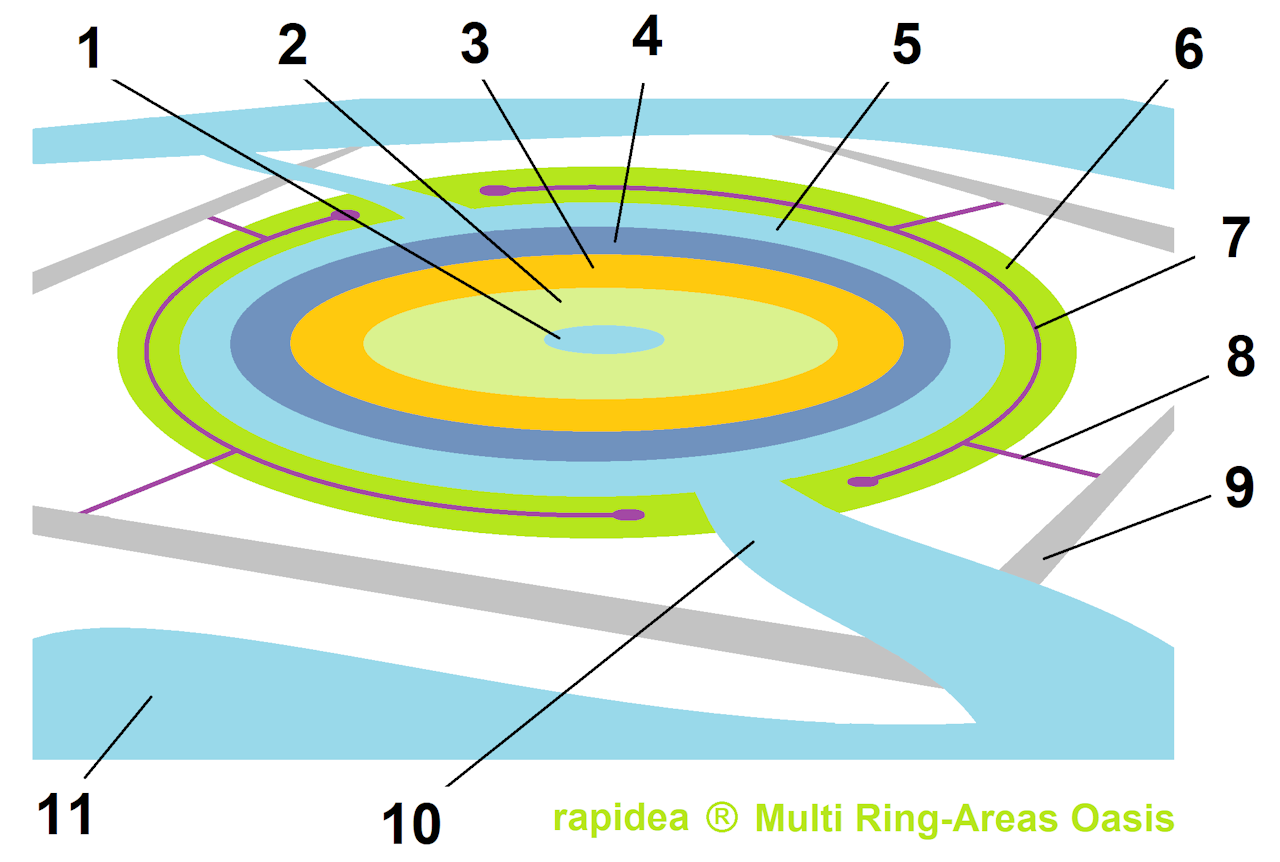
Image 1: Principle of a multi ring-areas oasis
Due to the increase in the global population and growing human needs, the persistent destruction of nature and negative climate changes initially appear to be logical and unavoidable consequences. In order to sustainably counteract the steadily advancing shifts in the ecological system and climate and restore an adequate balance between decisions for the present and the future, it is necessary to pursue new solution approaches. Too many decisions are still made within the perspective of benefits for the “here and now” and through such decisions in favour of the “here and now”, our future environment is being irreparably destroyed. The demands for the protection of nature and climate need to receive significantly higher priority over all other demands. For all measures that, for example, interfere with or have a negative impact on nature and climate, there must be compensation through measures with a positive influence on both.
Concerning this, the multiple and global implementation of “Multi Ring-areas Oases” can offer a promising solution approach, as explained by the authors Ingo Bruchhold (rapidea® Smart Plant Engineering) and Frank Eismann (civil engineer and freelance architect) in their technical article. Since, in the following description of the Multi Ring-areas Oasis, the implementation of technologies such as piping and filter systems, fittings, control and sealing technology, canal systems and emergency sluices is required, the authors would also like to address readers from the fields of plant and valve construction.
Regeneration and protection of nature
A multi ring-area oasis is a region-specific and optimally adjusted combination of ecological island, biotope, leisure park, food production centre and infrastructure. Through a consistent division of functions within the oasis, all core demands can be realised, that must be met for a stabilisation and regeneration of the ecological system and the protection of nature. This includes taking into account general societal interests in the use of land, as far as those requirements do not contradict the demands to protect nature.
Characteristics of the multi ring-areas oasis
- Circular flow of natures processes
- Encouragement of the soils fertility
- Cleanliness of the areas, lakes and waterways
- Prevention of sealing areas
- Support of regionally typical biodiversity
- Provision of a habitat for flora and fauna
- Cultivation of high-quality food products
- Short transportation routes for food products
- Deployment of environmentally friendly infrastructure
- Usage of natural resources
- Positive influence on climate and nature
- Opportunities for recreation and leisure activities
- Consistent separation of functions per area
- Reciprocal protection of the areas through a ring structure
Description of the multi ring-areas oasis consisting of at least six subareas
- Subarea 1: Lake, underground cavern landscape, native flora and fauna, free and undisturbed
- Ring-area 2: Land, underground cavern structures, native flora and fauna, free and undisturbed
- Ring-area 3: Above- and underground high shelving plantations, cultivation of, for example, fruits, vegetables, spices, mushrooms, particularly for consumption in the nearby area, in harmonised symbiosis with the high shelving aquariums
- Ring-area 4: Above- and underground high-rise aquariums, cultivation of, for example, edible fish, mussels and algae, in harmonised symbiosis with the high shelving plantations
- Ring-area 5: Ring shaped lake, canal 10 to the waterway network 11, piping system with filters and an emergency sluice to the lake on Subarea 1
- Ring-area 6: Park complex, walking trails 7, feeder road 8 to the surrounding road network 9, playgrounds and sports facilities, underground building complexes, standard features
- Ring-area (optional 1): Hotels, pensions, pavilions, camping and sports facilities, swimming pools, gastronomy
- Ring-area (optional 2): Residential and administrative buildings, schools, craft, trade
- Ring-area (optional 3): Ring shaped railroad line, bypass road, cycle and walking trail
- Ring-area (optional 4): Storage, deep boreholes for geothermal energy, power plants, industrial facilities
Plant construction for the realisation of a multi ring-areas oasis (examples)
- Subarea 1: Pipes, pumps, control and regulation technology, filters, sealing and sensor technology
- Ring-area 2: Pipes, pumps, control and regulation technology, filters, sealing and sensor technology
- Areas 3 and 4: Pipes, pumps, control, regulation and sensor technology, heating, cooling, sealing, filter and ventilation technology
- Between Ring-area 5 and Subarea 1: Pipes, filters, sensor technology, emergency sluice, valves
- Ring-area 6: Pipes, valves, pumps, filters, jets, fountains, water supply, control and regulation technology
- Ring-areas (optional 1, 2, 3): Pipes, valves, control and regulation technology, sealing and filter technology
- Ring-area (optional 4): Deep boreholes for geothermal energy, storage and water reservoir, power plants, control and regulation technology, valves, industrial facilities
Implementation of a multi ring-areas oasis
Outside urban areas, as for example on open field or in deserts, multi ring-areas oases, from a technical perspective, can be relatively easy realised. They thereby serve as a support of nature’s healing and preservation, equivalent to an artificial organ in a human body. Within urban areas the implementation of a multi ring-areas oasis is more challenging due to the already existing infrastructure but it can still be feasible, as shown by the following example project concerning the redesign of the “Tempelhofer Feld” in Berlin.
Until 2008, the “Tempelhofer Feld” was an internationally used airport. During take-off and landing, airplanes distributed mostly unfiltered residues of burnt fuel. Noise from their engines and turbines negatively impacted the well-being and health of people and animals in the surrounding area.
In the ongoing debate concerning the future use of the “Tempelhofer Feld”, arguments emphasising economic, recreational or environmentally friendly use are presented in sharp contrast. As a compromise solution, considering all of these arguments, it seems a suitable choice to implement the following example project for a multi ring-areas oasis.
In the core area, a biotope consisting of a lake 1 and a green area 2 is located, wherein the flora and fauna can develop undisturbed both above- and underground. The biotope is protectively enclosed by ring-area 3, on which the already mentioned high shelving plantations are located both above- and underground. These again are surrounded by ring-area 4 and its above- and underground high-rise aquariums. These areas are enclosed by a ring-shaped lake 5, which is connected to the waterway network 11a and 11b via the channels 10a and 10b. These channels are led across existing rail tracks, abandoned canals, green areas, lakes and ponds as well as across already or soon to be closed streets. The ring-shaped lake 5 is connected with lake 1 in the core area via a piping system, filter systems and an emergency sluice. An additional ring-area 6 is developed as a park complex featuring walking trails, connections to the surrounding infrastructure, playgrounds, sports facilities, an underground building complex with integrated climbing towers 12 and a daylight guidance system, an underground building complex with accessible fountain 13 and a glass dome with daylight guidance systems and event venues, as well as other typical features such as, for example, lighting, toilets and drinking fountains.
Key to images 4 & 5:
- Climbing towers 12
- Fountain 13
- Underground building complex 16
- Access (stairwell) with light shaft 17
- Green area 6
- Glass dome with daylight guidance system 18
- Accessible fountain-area 19
- Glass dome 20
- Fountain jets 21
- Daylight guidance system 22
- Climbing towers 23
Closing remarks and outlook
Multi ring-areas oases are a sustainable contribution to the regeneration of the ecological system and to the protection of the climate, while also fulfilling general societal demands on the use of land. Through this type of “artificial organ”, damages to nature can be compensated in the short term and repaired in the long term. Spread worldwide, these multi ring-areas oases can initiate and support a healing process in nature. They have a positive effect on the ecological system and the climate as well as on economic and societal matters. These advantages lead to a high motivation to realize many such multi ring-areas oases. On undeveloped land and in desert regions, as well as in densely built-up city areas (see example project: “Tempelhofer Feld” Berlin), multi ring-areas oases can be implemented advantageously regarding ecology and climate. In doing so, they furthermore secure new habitats for humans, animals and plants.
About the authors
Dr. -Ing. Ingo Bruchhold
rapidea® Smart Plant Engineering
bruchhold@rapidea.de
Dipl. -Ing. Frank Eismann
Civil Engineer & Freelance Architect
info@architekt-Eismann.com
Translation from German to English:
Katharina Schweimler
katharina.schweimler@architekt-Eismann.com
About this Technical Story
This Technical Story is an article from our Valve World Magazine, September 2025 issue. To read other featured stories and many more articles, subscribe to our print magazine. Available in both print and digital formats. DIGITAL MAGAZINE SUBSCRIPTIONS ARE NOW FREE.
“Every week we share a new Technical Story with our Valve World community. Join us and let’s share your Featured Story on Valve World online and in print.”