

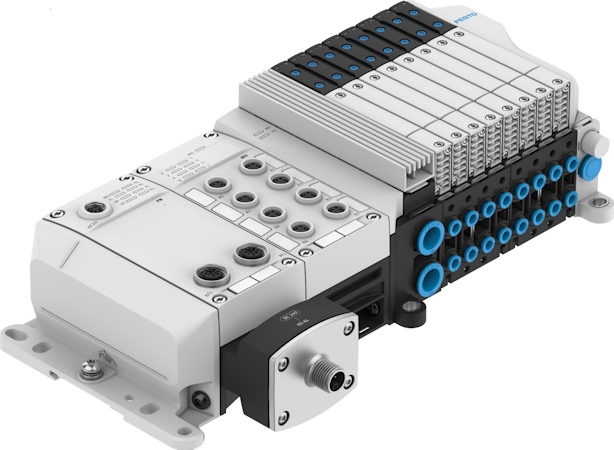
Festo has expanded its VTUX valve terminal platform with a series of new functions and connectivity options that give machine builders greater design freedom, improved energy efficiency, and enhanced digital capability. Building on the highly cost-effective VTUX base system, the latest additions include advanced communication via Festo AP, new smart vacuum and I/O options, and new energy-saving valve functions. Together, these enhancements enable the creation of more compact, responsive, and future-ready machines-reducing compressed air consumption, simplifying architectures, and lowering system costs.
The VTUX was initially launched with basic capabilities to meet the broad needs of most volume users of pneumatic solenoid valve manifolds. Since its introduction, there has been a continuous roll-out of new features, making things even easier for users. The basic VTUX valve terminal is carefully cost-optimised through design and manufacture, delivering high flow rates and virtually unlimited modularity. The valve modules can be arranged freely and are compact and lightweight, saving time, space, and weight in the machine. The ability to ‘split’ manifolds cost-effectively without having to pay for additional fieldbus nodes means designers can arrange their layouts for ease of assembly and simpler maintenance. Crucially, the VTUX minimises piping run lengths, which can improve response times and cycle rates at the same time as reducing wasted ‘dead air’ volumes.
However, the greatest benefits result from Festo considering not only how to mount and connect pneumatic solenoid valves across a machine but also the surrounding architecture. VTUX now uses Festo AP (Automation Protocol) to optimise digital communication. This brings flexibility, enables open architectures, and allows seamless integration of electrical and pneumatic automation.