


Ultra Ratio Reducing valve
The development and deployment of specialised Ratio Reducing Valves marks a necessary evolution in flow control technology.
By Peter Telle, Ultra Valves
The Pressure Reducing Valve (PRV) is a vital tool for network management, controlling transient pressure and reducing non-revenue water (NRW) loss. However, its traditional reliance on complex external pilot systems introduces vulnerabilities. While standard PRVs maintain a set downstream pressure, extreme high-head systems—common in deep mines or mountainous municipal networks—demand a valve dedicated to safely dissipating vast amounts of pressure before distribution. This is one of the functions of the Ratio Reducing Valve (RRV).
The core challenge of this duty is not precise set-point regulation, but gross pressure dissipation while protecting the valve’s material integrity against high velocity and cavitation. An RRV is engineered to maintain a fixed reduction ratio between inlet and outlet pressures (e.g., 3:1 or 4:1), making it fundamentally different from a piloted PRV.
 About the author
 About the author
Peter Telle is the Founder and CEO of Ultra Control Valves (UCV), a specialist engineering company based in South Africa. A qualified engineer (BSc Mech Eng, MBL), Telle first entered the valve industry in 1978 and dedicated his career to the development and application of Automatic Water Control valves.
UCV focuses on delivering engineering solutions where Total Cost of Ownership (TCO) and reliability are paramount. Telle’s practical expertise in Water Hammer and Surge Analysis is supported by UCV’s association with leading academic and industry partners.
Engineering for controlled energy dissipation
The design of a reliable RRV focuses on robust simplicity and staged pressure reduction to manage energy safely.
- Fixed piston actuation: Unlike standard PRVs that use sensitive, multi-component pilot systems, the RRV relies on a simple, robust piston mechanism. This mechanism mechanically maintains the fixed pressure differential across the valve, regardless of flow variations. This eliminates the intricate tubing and small orifices that are prone to fouling and calibration drift in conventional systems.
- Series stability: A key technical advantage is the valve’s stability when multiple units are installed in series. In applications where upstream pressure is too severe for a single component, two or three RRVs can be installed sequentially to stage the pressure reduction. This capability is essential, as pilot-operated PRVs typically become hydraulically unstable when installed in series, rendering them unsuitable for this type of ultra-high-pressure dissipation.
- Material integrity: Given the extreme service conditions (up to 150 bar), internal components, and particularly the trim, are subject to intense erosive forces and the risk of cavitation. RRV internals are therefore manufactured from highly resistant materials like hardened stainless steels or specialised metallic alloys. The emphasis is placed on longevity under sustained, severe pressure drop.
Operational reliability and TCO impact
The RRV’s simplified and robust engineering yields distinct operational and financial advantages, directly contributing to a lower Total Cost of Ownership (TCO).Key features are:
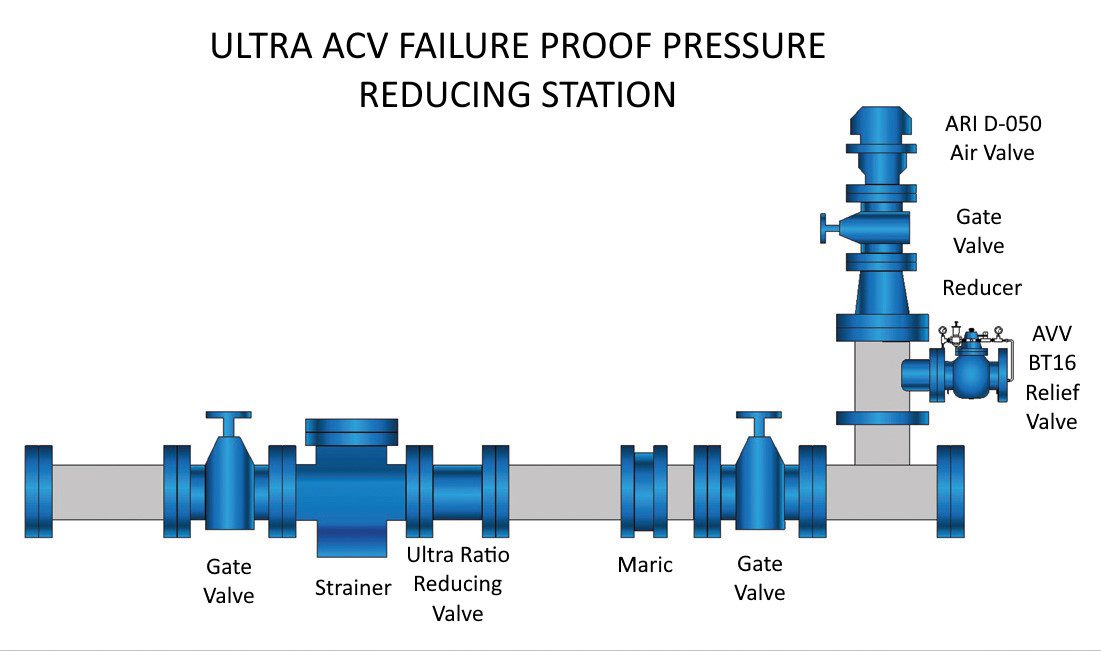
Superior fail-safe capability – This is perhaps the RRV’s most significant reliability feature. Unlike pilot-operated PRVs, which can fail catastrophically in the open or closed position, the piston-actuated RRV is inherently failure-proof in its duty cycle. If a seal or O-ring is compromised, the valve does not fail entirely. Instead, a “telltale” stream of water shows through the piston breather hole, indicating a minor leak. Critically, the valve continues to perform its pressure-reducing duty, allowing maintenance to be scheduled rather than reacted to as an emergency. This feature led to the design of an “inherently safe” pressure reducing station, which can be safely used in place of a break pressure tank.
Simplified Maintenance – The simple piston mechanism means maintenance shifts away from complex pilot circuits. Technicians focus primarily on inspecting and replacing specialised soft seals, drastically reducing labour time, troubleshooting complexity, and the inventory of spare parts required.
Pipeline protection and longevity – The RRV is essential for pipeline segmentation. By safely and reliably stepping down the bulk of the pressure head, it ensures that all downstream equipment, which is typically rated for much lower pressures, operates within its optimal design range. This protective function significantly extends the lifespan of the entire network.
Conclusion
As global infrastructure demands greater resilience and efficiency, the engineering focus must shift toward robust simplicity. The development and deployment of specialised Ratio Reducing Valves, capable of handling large sizes (up to 500mm) and extreme pressures (exceeding 150bar), marks a necessary evolution in flow control technology. By focusing on mechanical reliability, staged pressure dissipation, and critical fail-safe design, engineers can specify solutions that offer predictable performance, minimal maintenance intervention, and a demonstrable reduction in long-term operational costs. This innovation ensures the guardian of the water network can meet the escalating requirements for sustainability and TCO in the 21st century.
Dive Deeper into Valve World
Enjoyed this featured article from our December 2025 magazine? There’s much more to discover! Subscribe to Valve World Magazine and gain access to:
- Advanced industry insights
- Expert analysis and case studies
- Exclusive interviews with valve innovators
Available in print and digital formats.
Breaking news: Digital subscriptions now FREE!
Join our thriving community of valve professionals. Have a story to share? Your expertise could be featured next – online and in print.
“Every week we share a new Featured Story with our Valve World community. Join us and let’s share your Featured Story on Valve World online and in print.”